Monday, September 03, 2012

Becoming Ken Russell!!!


All fans and advocates of Ken know the name Paul Sutton. In the fellowship he's one of the most committed people to preserving Ken's oeuvre for posterity particularly the first 35 shorter films that Ken did for the BBC. Just as Shade Rupe has worked tirelessly to keep Ken's major studio works before the public, and Ian Fisher keeps the online fires burning, Paul is assuring that the smaller films (films that the UK public paid for) are no longer buried and hard to see. As it stands now, there is only a region 1 release of a half dozen or so films. A region 2 release of some very rare later works is due in a year....makes no sense really. Is it really that challenging for the beeb to make Ken's work available? Work that TV licensing fees paid for?

So in an effort to continue the tradition of Ken Russell scholarship (Ken being the star scholar thus far ;) Paul has authored the first of what is apparently going to be a staggering five volumes of sorely needed "Russell indepth". Started in 2007, Becoming Ken Russell: The Authorised Biography of Ken Russell: Volume One (Volume 1) is now been made available and here is Paul's take on it:

"Ken Russell was thirty-two years old in 1959, having been rejected by the British Film Industry because he didn't have the right family connections or the right school tie. Without connections there was no chance of his having a career in film. Until the industry collapsed. The failing studios at Lime Grove, where Alfred Hitchcock made The 39 Steps, and at Ealing, where Alec Guinness closed a series of unprofitable comedies with The Ladykillers, were now in the control of the BBC. And the BBC were looking for new talent.

Hired as an independent filmmaker, Ken Russell made seven short 35mm films in his first year at Lime Grove and at Ealing. The films were about dance and painting, architecture, comedy, poetry and music. The seven films were all about England. And they were all about him.

The Seven Ken Russell Films of 1959 advanced the art of cinema, acted as a sort of `blueprint' for masters such as Stanley Kubrick, and redefined the meaning of `English Cinema'. The films stand with the best made anywhere in the world that year. The year Ken Russell `became' Ken Russell.

Using tens of thousands of pages of original documents, decades of letters, and hundreds of interviews with Ken Russell, his family and his colleagues, Paul Sutton's multi-volume biography of Russell is the most complete portrait of an English film artist"


Labels: , , ,

Monday, July 02, 2012

For these hard times

 "Tommy at last realizes he’s not a spiritual guide, he’s one more human being, who needs to learn from other people, from all humanity.  At last, he sings triumphantly, “Right behind you, I see the millions." Ascending to the mountaintop, he reaches the peak and triumphantly greets the rising sun, a huge, warm, reddish sphere that en-haloes his entire body in a victorious stance, legs apart, arms spread in exultation. This is only the second time the full circle of the sun has appeared in this movie filled with shiny spheres and moons. The first time was in the first scene, where Tommy’s dad, in mountaineering garb, reached the peak of the same mountain at sunset, and then began his descent, as we know, into death. Tommy returns to the mountain and the sun reunites him with his father and his vital inheritance as a living human. 

With this closing scene, Russell has literally fitted the entire opera between the two celestial spheres, the sun and moon, raising every human’s battle to break out of the lies that conceal reality to an epic level. Transcendence, Russell seems to be saying, isn’t achieved by playing human games like pinball, in which you progress through a linear pattern to higher and higher numbers, and judge your success by popular acclaim.  Rather, it is an adventure that you do not begin until you throw over the oppressors that prevent you from speaking the truth.  Russell concludes a work that takes over your senses at high speed and high volume with a message that, although born from the turmoil of the sixties, will resonate meaningfully for generations to come" - by Charles Carreon


 THE UNIVERSAL MESSAGE

Meher Baba


I have come not to teach but to awaken. Understand therefore that I lay down no precepts.
Throughout eternity I have laid down principles and precepts, but mankind has ignored them. Man's inability to live God's words makes the Avatar's teaching a mockery. Instead of practising the compassion he taught, man has waged crusades in his name. Instead of living the humility, purity and truth of his words, man has given way to hatred, greed and violence.
Because man has been deaf to the principles and precepts laid down by God in the past, in this present avataric form I observe Silence. You have asked for and been given enough words — it is now time to live them. To get nearer and nearer to God you have to get further and further away from "I", "My", and "Mine". You have not to renounce anything but your own self. It is as simple as that, though found to be almost impossible. It is possible for you to renounce your limited self by my Grace. I have come to release that Grace.
I repeat, I lay down no precepts. When I release the tide of Truth which I have come to give, men's daily lives will be the living precept. The words I have not spoken will come to life in them.
I veil myself from man by his own curtain of ignorance, and manifest my Glory to a few. My present avataric Form is the last Incarnation of this cycle of time, hence my Manifestation will be the greatest. When I break my Silence, the impact of my Love will be universal and all life in creation will know, feel and receive of it. It will help every individual to break himself free from his bondage in his own way. I am the Divine Beloved who loves you more than you can ever love yourself. The breaking of my Silence will help you to help yourself in knowing your real self.
All this world confusion and chaos was inevitable and no one is to blame. What had to happen has happened; and what has to happen will happen. There was and is no way out except through my coming in your midst. I had to come, and I have come. I am the Ancient One.

Labels: , ,

Monday, March 19, 2012

Ken Russell on The Devils


On March 19 my masterpiece — Britain’s masterpiece — The Devils is to be released on DVD by the BFI in a UK director’s cut (ie, the master I chose before the Americans butchered it) with all kinds of extras.

I know this will please a fair number of crazed film fans, some of whom, like myself, have been driven crazy precisely because The Devils has not been allowed a proper release or re-evaluation since it came out in 1971.

What a long walk through Hell it’s been for all of us who wanted to see the film rescued from where it has languished in dust for 40 years, hidden away in vaults where even a resourceful hero like the film commentator Mark Kermode (of The Culture Show and BBC Radio) would have trouble finding it.

Was Mark joking when he told me of his Indiana Jones search in 2002 for the infamous missing segment of The Devils known as “the Rape of Christ” and found a handwritten note on the film canister: “This film shall never see the light of day”?

Is it true the film was so thoroughly buried that only one person could be found to provide an original director’s cut, having squirreled a copy into his private collection in 1971: Martin Scorsese?

In the meantime, over the last 40 years, there have been shredded versions, mercilessly cut American bootlegs, scan-and-pans from internet glimpses, copies made from ancient VHSs, rip-offs that frustrated the people who owned the film (Warner Brothers, originally) and the generations who want to be allowed to see it intact.

I know how good it is. But a new audience, and those too young in 1971 to ascertain what it was they were seeing, deserve a chance to claim the film as their own: as British, as a classic, or even as something they honestly hate. (Warner Bros had an ad: “You may love this or hate it, but you will never be bored!”)

The brave work by Vanessa Redgrave as Sister Jeanne of the Angels and Oliver Reed as Father Grandier, Derek Jarman as set designer and music by Peter Maxwell Davies deserves to be seen and heralded.

I came to the movie by way of Jonathan Whiting’s 1960 play and the original book by Aldous Huxley, the author of the non-fiction The Devils of Loudun, an historical account of a charismatic priest and group of Ursuline nuns in the 17th century caught in a political contretemps.

Two power struggles have parallel expression: the civic battle of Church and State, with Cardinal Richelieu pressuring the French King Louis III over property rights to the City of Loudun. The other power struggle is more personal and all other battles get played out through this personal confrontation: a sex-starved nun, head of a convent, with a severely twisted back and body, wreaks vengeance on the gorgeous and sexually overactive head priest after whom she lusts.

Amid religious wars, the plague, the Inquisition, the ethnic cleansing of Huguenots and Protestants, the unlimited power of the few, the disturbed and hopeless masses, the squalor, impoverishment and a pre-scientific worldview, these two anti-heroes battle it out without actually having a conversation or knowing the larger agendas that will use them as pawns.

Priest Grandier thinks he is fighting for sanity among the superstitious, Devil-obsessed medieval cultists and the soldiers who want to destroy his city walls; and Sister Jeanne thinks she is fighting for her chance at having a romantic sexual liaison with him.

Jeanne takes her revenge for Grandier’s sexual indifference to her by claiming to the Inquisitors that he has possessed her in his true form as an incubus of the Devil. Attention-seeking in 1636 enjoyed a support system that wouldn’t emerge again until our current times, with reality shows and The X Factor.

Bored and isolated, the nuns catch the hysteria of Sister Jeanne’s claim and start giving regular matinee and evening “shows” of possession: acting for the crowds by throwing off their habits and rolling about lewdly.

Because of The Devils in 1971, I have been accused of Devil-promotion, nun-lust, torture-porn, church-desecration and bad taste. I plead guilty only to the last, which is proportionate to my good taste, in my humble opinion.

I’m a good Catholic boy who finds it my duty to the Faith to question hypocrisy, chicanery, hysteria and mob decisions. Frankly, I don’t know what the fuss is over The Devils. Shocking? Passionate? Brave? Noble? Isn’t that a good thing?

It’s not a blasphemous film; it’s a film about blasphemy. The Jesuit Rev Gene Phillips, of Chicago’s Loyola University, teaches it as “the best film about the Catholic Church ever made”. I’m a true believer in the separation of Church and baser instincts like hypocrisy, power, exploitation of innocence.

All right, so I like the visual, the dramatic soundscape, the interwoven and complex, the fully developed characters, and it all gets too rich for some people’s blood. But my inspirations are Fritz Lang’s Metropolis and Cocteau’s Beauty and the Beast, and imagination must have its say.

In my films, you can either pay attention and receive an emotional pay-off or just enjoy them as spectacles of the extremes of behaviour — your choice. But I scrupulously followed the history and the book, with those instruments of torture — the same wheel of torture propped aloft where St Catherine met her doom; or the enemas intended to root out the devils that were thought to live in the lower intestines.

The wasps in sucking cups, the stuffed crocodile, were all actual cures not much different than our contemporary beauty fads for fish on the feet or pins-on-rollers perforating the face. Yes, green lipstick was the rage at the time. And the modern-looking city: it was brand-new at the time. I gave Jarman one cue: Huxley’s line, “The exorcism of Sister Jeanne was the equivalent of a rape in a public lavatory.” Hence, the white tiles.

I am most proud too that I made the film with my brilliant and sexy hand-picked company of actors: Oliver Reed, Judith Paris, Max Adrian, Brian Murphy, poet Christopher Logue, Dudley Sutton, Twiggy (playing a cameo), Graham Armitage. Glenda Jackson declined to be in it, but her heart is there — her relentless love of truth.

Gemma Jones, the virgin heroine, is wonderful, a diamond-pure soul who awakens Father Grandier’s better nature. Michael Gothard plays a creepy cult-leader exorcist with issues. Georgina Hale is a wronged and sexy temptress, Murray Melvin is a judgmental scion of the Church.

The magnificent Vanessa Redgrave plays Sister Jeanne with such brave impulses and majestic intelligence that it’s like watching an oil painting by Breughel or Bosch come to life before your eyes. “I’m beautiful,” she cries in protest against the jeers, during a dream sequence in which her hunchback is straightened. That she is. Beautiful and alas, twisted.

There are so many significant choices with which Ms Redgrave startles us: a surprise expletive, a melting into desire, a sudden terror of victimisation in one so dominating, a cold imperiousness, a confidential clarity, a vengeful lunacy, all vying for expression in the personality of a nun who is obviously a genius but isolated by the times and her office to the point of self-destruction and revenge; her interpretation is harrowing and poignant at once.

When Vanessa and I were reunited to watch a special showing of The Devils together at Lincoln Centre in New York in 2010, she and I found ourselves chuckling at much of it. Aside from the pleasure of being in one another’s company again, were we responding to a terrible tale that had suddenly become too funny, too camp?

No. There are elements — the scenes with the apothecary and surgeon, for example — just so on the mark, so timeless, extremely modern. The venal instincts of people under pressure are never out of date. I daresay The Devils was ahead of its time so much as to have finally caught up with it.

I know in 1971 the censors weren’t prepared for naked nuns and pubic hair. The Americans wanted every hair on the cutting room floor. Oh dear. I’d already given the actress-nuns £150 to shave their heads; it was too late to put them in underwear; the film was done. These were nun characters going from one extreme of shame-based behaviour to the other, to exhibitionism. How could I write fig leaves into a script on truth? So, I didn’t, and the Americans cut out so much footage as to make the film disturbingly fragmented.

On live TV, the film critic Alexander Walker contemptuously dismissed my film, repeating his scathing review and adding that I show Reed’s testicles crushed. (There were NO crushed testicles, not even implied — maybe Walker was confused in that a marble statue has his pelvis broken; this hurt Jarman more than anyone else — painstakingly constructing such sets to see them destroyed was hard for him.)

I took Walker’s review in the Evening Standard, rolled it up and bopped him one on the head while cameras rolled. If I meet him on the other side I shall know I did not make it to Heaven.

John Trevelyan, the official BBFC chief censor, old colleague, was much more reasonable and circumspect. He asked only that a 12-minute segment in the middle be cut as well as a few masturbatory bits. Fair enough.

But I’d rather have the film seen, even censored. The new DVD version is as close to its original form as I approved it and as Mike Bradsell, my long-term editor, shaped it, in a time when editing involved actual film reels and splices.

The Devils is Arthur Miller’s The Crucible with open sores, open bonfires, court intrigue, the King shooting Protestants for sport, the callous and ludicrous behaviour of the Inquisition, the two-facedness of the King’s soldiers and sex-deprived nuns. It’s about the corruption of a whole town and the man at the centre who defies it.

Polanski gave The Devils an homage in The Pianist, whether he realises it or not (take a look at the Warsaw ghetto when it tumbles). And may I just say, The Devils has a happy ending. Ambivalent, yes, but I swear it. Anytime you live through that and keep going, more aware of right and wrong and the self, it’s happy.

Oliver and Jarman may have been exhausted by their hard work on The Devils, but it’s Oliver Reed’s best work. He rivals any great actor for power and nuance and earns his title of sexiest man in films.

It was certainly a happy experience for me. Vanessa taking up collections every day for the disenfranchised, Jarman and I sparking off each other; my psychic editor, Mike Bradsell, able to achieve what I wanted in every instance, David Watkin filming impeccably, the young Peter Maxwell Davies finding that uncomfortable sound in his brilliant score.

I made a good film, for England and the world, and for Huxley, who said in his letters, “I pity the poor chap that is making a film of the Devils.” I can’t help but be thrilled that my film will have its day. We’ll turn down the lights, play the DVD, my wife will hold my hand and we’ll have a blast, waiting for that moment when Reed declaims, “Satan’s boy I could never be!”

From The London Times 13-3-2012

Labels: , , ,

Monday, January 23, 2012

Ann-Margaret 's Pin Up Couture in Tommy - Designs by Shirley Russell

(And we are back folks. While I still don't believe he blasted off for infinity, it would be a disloyalty to Ken's staggering legacy and the collective consciousness if we just stopped or tapered off here. I'm now blogging about Ken indefinitely and as often as possible. Please go to Ken's official website, Savage Messiah, and his Official Facebook Page for news including links. Back to Tommy. Back to Baba. Back to Ken. A tired and paranoid planet needs his joy and we miss him while we celebrate.)


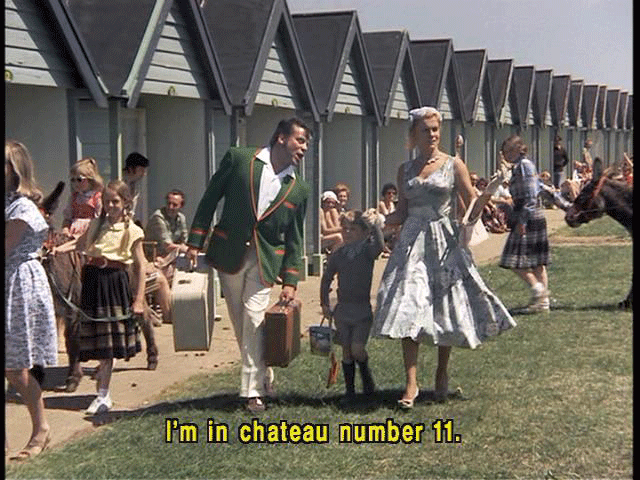
(We welcome you to Bernie's Holiday Camp and some of the most marvellous 1950's reproduction clothing ever created. As usual a huge thanks to America Buddha and their screen caps library of Ken Russell's film of Tommy.)


With so much reproduction vintage and Pin Up clothing everywhere you look these days it is easy for even bona fide fashionistas to forget what any drag queen, retro-burlesque artist or clothes -horse collector can tell you; that less than a decade ago all these great swing dresses, crinolines, corsets and rompers you see today were very hard to find and impossibly expensive. Once upon a beaded cardigan, if you actually found your size it often fell apart or had to be altered. A magazine would show a handmade item and you'd never be able to find it. You'd see a picture of a Shaheen wing bust dress or a Cole of California playsuit, dream of having it recreated custom made and quickly find that dream was only for the very wealthy. Now with the internet and especially ETSY,  vintage repro and custom CAN come true for anyone. Of course to stand out in a sea of  Heartbreaker and Hell Bunny, the best design inspirations come from films and easily the best reproduction 1950's couture in any film is seen in the childhood sequences in Tommy.

When Shirley Russell, the Edith Head of British costume design, created these masterpieces, it was the mid 1970s and just as she'd flawlessly and exuberantly brought the whimsical late 1920s and 30s to life in The Boyfriend, she hearkened back to the British 1950s with equal aplomb. It is clearly evident from many art, fashion, music and films from the1970s, that both the 1920s and the 1950s saw major artistic revivals. Yet where Grease and America Graffiti are all itchy lettermen sweaters and stiff crinolines, the designs for Tommy are fluid and sensual. And while Cha Cha DiGregorio's prom dress (worn magnificently by the recently departed Annette Charles) is one very hot masterpiece (complete with attached matching panties) the rest of Grease features mostly costumes that scream "1950's costume" with the clothes literally making the characters what they are. Unlike Olivia New John's black spandex, Shirley's costumes for Ann melt into the scenery and are actually wearable, making Ann's character, Nora Walker especially believable. (Remember both films are musicals with Tommy having zero dialogue). Nora dramatically ages in the film and goes from the teenager in love wearing tweedy fell pants to pensive early 1950s British Post war widow to nouveau riche chrome camp goddess to doomed alcoholic cult greeter.

( Surely in heaven starring as Aldonza in Ken' Russell's  film of "Man of La Mancha' with Jesus Christ as Don Quixote: Annette Charles 1948-2011)


As for Annie Margaret she is, along with Rita Moreno, perhaps the only true "singer, dancer, actress"  in Hollywood history. Her talent as an actress in Tommy goes leaps and bounds beyond her fabulous hourglass figure and what most of her peers could have done with the role. Ken, known to have a relatively casual coach of actors on the set, was given by AM a performance that includes camp, sadness, adroitness and a female vibration so powerful that no actress should attempt the role on screen again.

Ann-Margaret's  Pin Up Couture Wardrobe From Tommy:


1.Palest Mint Pastel Green  Tropical Print Swing Dress with Crossover Bust

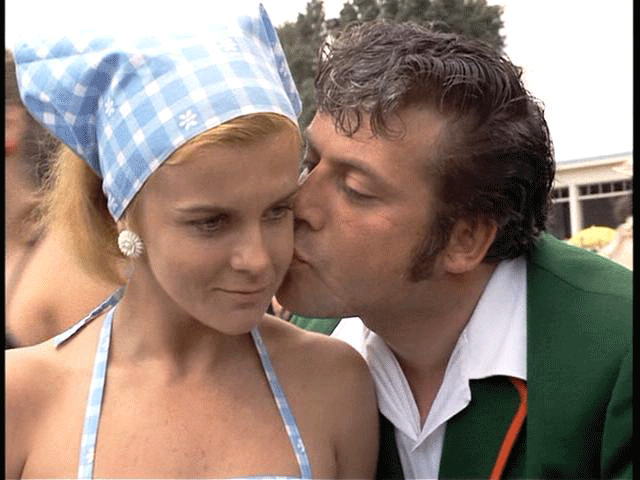
2.Sky Blue  and White Gingham Halter Romper/Swimsuit with matching scarf & attached skirt

3.Pale Blue Floral Ball Gown with Pink Roses on an Organza Overlay (my personal favourite)

4.FlameRed fold over origami wing bust swing dress with spaghetti straps, Bow belt with long centre sash and white batik style roses on the skirt.


5.Cornflower Blue Atomic Galaxy print swing dress with elbow length sleeves and plunging portrait collar neckline

6.Bright Red Asymmetrically tiered pleat crepe floor length Christmas hostess gown 3/4 sleeves and plunging Statement Neckline

(all five dresses are worn with a crinoline or hoop skirt for volume. DO enlarge pictures to see the details)


1. The Holiday Camp arrival dress is more a look. Nora has a shell hat, crochet gloves, dazzling day jewellery, ivory open toe pumps and a pink handbag  (see first photo above). As it was in this era, the working class of both sexes in Britain all dressed smartly. Yet she's also a widow and a single Mum who is still very young, romantic and justifiably naive. The Green Coat has already chatted her up ("I'm in chalet number 11") and she's not even unpacked. The dress has that wonderful wrap bust that flatters anyone with a subtle floral print. This ensemble says "I'm young and fetching but not easy".


2. Ken now has Nora in the ultimate Pin Up Playsuit; wholesome and staying joyously a float with Frank's eager help. This is the most light hearted gingham romper ever! Though seen only in retro-style Pin Up photography these days, you can actually swim in one of these and most are so well made that they still hold up. Nora's is in my preferred playsuit cut as a small waist, wide hips and long legs like I have don't rock a boy cut nearly as well as an attached full skirted micro-mini. During the "Lovely Legs Contest"  which Nora wins,  Ken ensures that the other bathers (most likely married women) wear boy cut suits while she stands out almost like a water ballerina, the only one in a matching head scarf . As Tommy cheers nearby and Frank Hobbs passive aggressively comes on to her she looks particularly vulnerable.
(I reversed the order of the last two pictures so you can see the suit clearer)


3. We now cut to a glittering ballroom with Nora in a lavish formal evening gown. She is getting caught up in being desired after being alone for so long. Once again Nora is dressed as the picture of class; her hair is swept up and decorated with a pink rose to compliment the floral embroidery on her organza gown and set off her dazzling earrings. The gown is floor length with wide regal shoulders and a flattering mid cut neckline. The look can easily be misread as "Easter Lamb" after she's so easily seduced in her holiday chalet later that night but she clearly told Frank "until I'm one my heart won't rest..." This scene breaks the "Frank Hobbs is evil and Nora Walker is a victim myth" regarding Tommy and establishes that these are two people falling in love. (In this scene you see a haze which looks like cigarette smoke but it was in reality the pier itself they were filming on had caught on fire! The whole crew was evacuated needless to say and Ken included the exterior shots in the final part of the film.


4. And the newly marrying war widow bride wore scarlet with pride! Love how Ken has Nora bouncy and cheerful  in flaming red the day after her one day relationship was consummated. No walk of shame here.  The dress is a classic take on the Shaheen wing bust but with the points worn delicately up. Between the batik scattered white roses and the long sash (rarely seen in reproductions today), black hose and pumps,  the whole ensemble (nearly sans jewellery) has that oriental minimalist feel so popular in the 1950s. Oliver Reed makes the ultimate ageing Ted down to the brothel creeper soles come to life with each swagger. Perhaps picking up psychically that his step father's ensuing folly will ultimately lead to a labyrinth of pain and mis-adventure for his young mind,  Tommy loudly announces the plan for his own camp "when I'm big" to his oblivious folks.


5. Now he is deaf, now he is dumb, now he is blind and now they must save face after shocking him into severe autism. Russell has the family inside a tunnel walking in step like troops. What better way to paint the image of the "perfect family" then outfits made from the same whimsical and carefree print?! I see sun eclipses, atomic looking nine pins, stars and all manner of merry futuristic things. I love how Nora is not corseted and pushed up and out. She's natural and feminine. Honestly, those two get a bad rap; they were in love and had no idea that Tommy's father would return. The murder of course was wrong but it was also a crime of passion.


6. With it's extensive ruffled portrait collar, hoop skirt and seemingly endless pleated tiers, this lavish but stiff Christmas gown below signifies that Nora is now fully entrenched in keeping up appearances. This is the diamond accentuated transition piece for now after this scene, nearly all of Nora's clothing will over the top/ nouveau riche, futuristic and decadent- the 70's via the year 5555. Nora is now scarlet for good and we leave her lavish vintage pin up wardrobe to climb the mountain and find excitement on our own wish-lists.


In honour of those who tirelessly researching, sewing , creating and thus carrying on the loving tradition of Shirley Russell (aka The High Priestess and Alchemist of Vintage Costume), I've included a list of what I feel are today's première bespoke and Pin Up clothing revivalists:
(All made in the UK and the USA of course.)

Fables By Barrie  Made in San Diego. I am confident that there is nowhere on earth with more beautiful and dazzling whimsy and such flawless customer service. My Tolie Du Jouy one piece will be rockin this summer!


Dainty Rascal Reproduction Vintage does not get any better outside of  Pinewood Studios. Almost a dozen of Marilyn Monroe dresses lovingly recreated are just the start-Suzy Berricone can do anything. Expect her to be a major player in the international fashion someday. Made in beautiful Sonoma County.

Tara Starlet Creates the UK's premier vintage reproduction clothing. Whereas many of the big names in Pin Up Clothing  go for a  hyper-buxom 1950s Varga look, Tara Starlet offers clothing for the more mysterious, sensible, modest and wholesome. Designs are historical (Land Army dungarees), professional (30s and 40s suits you can wear to the office) and of course Sailor Pants in a dozen colours. Clothing for all sizes and body types UK sizes 6 (US 4) through 16 (US 14).


Labels: , , , , , , , , , , ,

Monday, November 21, 2011

Shelagh Delaney 1939-2011


Thanks to Ken Russell, the legendary film  *A Taste of Honey, became so much more to me and I discovered the woman behind it; the great Shelagh Delaney.  Being only a slight Smiths fan unlike all my friends and hubby who are nuts for them, I had no idea she'd been on the cover of  Louder Than Bombs until just now.

This week Shelagh is being remembered and sadly only slightly celebrated here in the press *(TV has been rubbish; nothing at all) for the genius she will always be. To anyone woman who has ever written a play about the real world  (especially of the working class) Shelagh flickered subliminally for decades along with Lorraine Hansberry her American compatriot. The GLBT community owes her a huge debt of gratitude as well for it was after sensing the auto pilot homophobia in Terence Rattigan's Variations on a Theme, that she was moved to write A Taste of Honey at the mind boggling age of 17. Feminists owe her a big debt too but then so does the average man who appreciates a smart and down to earth, earthy woman. It took a concerted group to create the sexual revolution and Shelagh work is the strongest effort waged in British theatre for certain. Nothing as yet has come along to properly take off where she let.

Shelagh will continue to inspire. Bless her.


*introduced to me by a now long lost beloved friend Danny Hardie Hardy last seen working at Boots on Bond Street and living in Nunnhead which is not unlike the Salford of London.

*That's the dumbed down world we live in. Ugly Elle MacPherson snorting Rhino powder and helping them all go extinct to Madonna's 25 million pound anti-Semitic sanitary towel advert. Shelagh Delany is too good for today's rubbish media

Labels: , , , ,

Monday, November 07, 2011

Tommy 4: Delivery Room Glee


There are no discernible dioramas in this scene but then I'd be hard pressed to find one in a medical environment even in an entire episode of Scrubs set to "Waiting For Godot". Hospitals are places that I thankfully thus far have spent little time in and I see them as sterile transition points or film sets for asylums. But Ken's Victory Day NHS has much going for it.

After the showgirls we have two lovely twin nurses and a "Father knows best/ every man doctor". As wasted teens, when the doctor would start to sing "a son" we'd all piss ourselves laughing. What a beautiful and realistic newborn Tommy is!


There certainly is a enough giggle and knock out gas to alter ones mood here.

(The heartbreaking dissolve into Captain Walker crashing with Ann-Margret and new born Tommy will be looked at independently at a latter post.)

Labels: , , , , ,

Variety Reviews - J. Edgar and references Ken's "Women In Love " Nude Wrestling Scene!


"True to Eastwood's understated nature, "J. Edgar" offers the "tasteful" treatment of such potentially salacious subject matter, though a more outre Oliver Stone-like approach might have made for a livelier film. With the exception of a few profanities (enough to land the pic an audience-limiting R rating) and a lone homoerotic wrestling scene so tame that Ken Russell's "Women in Love" feels like an X by comparison, the film could pass for something Warners would have released in an earlier era -- earlier even than many of the events depicted onscreen, as suggested by Tom Stern's cinematography, desaturated nearly to black-and-white."

Ken posted the Variety review a few days ago. Eastwood is a great director and DiCaprio is outstanding in all he does but they needed opera and burlesque theme here to REALLY show the world how gory J. Edgar Hoover was. (I actually own a hand signed letter (in pencil) hand typed by the late man himself. My much older late boyfriend's Uncle owned a bank in Omaha, Nebraska which was robbed and Hoover looked into it.)

What else to flesh out that classic example of  "the guy screaming loudest in church about 'sinners' has the most to hide" dictum but raging colours and Lisztomania style eye candy? (I answer this myself below...) From what I've seen the script writer was simply too kind and yet here was probably the closest to an official US Nazi that the world will ever see!! Hoover would hound people for checking out library books or going to a concert he did not like-even if they had ZERO leftist affiliations. My script would have had Jean Seberg and Paul Robeson show up as avenging angels ( he destroyed both of their lives) and Jean would hold up a mirror to show Hoover's femininity and latent homosexuality and Robeson would show  the reflection of Hoover's long rumoured black ancestry. (The fact he did not file his birth certificate until he was 43 is apparently glossed over as well.) Looks like Leo and Clint Eastwood did great with what they has to work with though even if it wasn't Alan Bates or Ollie Reed's phenomenal bodies framed by Ken's genius at understated psychological turmoil. And there I go stereotyping the man as glittery camp "visionary" blah blah blah! The film could have been closer to Ken's understated and comparatively (to some of his other films) sedate vision and benefited greatly as well I'm sure.

Labels: , , , ,

Monday, October 31, 2011

HAPPY HALLOWEEN!! Louse of Usher and The fall (temporarily) of joy


From the wonderful The Fall of The Louse of Usher, James Johnston and Lizi Tribble sing "Ligeia" their rock video depicting when Roderick Usher was the Mick Jagger of his era and he was number one with a bullet. The senseless killing of 49 very rare and endangered captive Tigers, Mountain Lions, African Lions, Lionesses, Monkeys, Bears and wolf in Zanesville, Ohio two weeks ago has created a great deal of sadness. In my spare time reserved for this project,  I drifted into reading dark, freaky books about the Rolling Stones and googling articles about their various wildness years, erotica and misadventures and I did have some great fun listening to the songs of  "Goats Head Soup" and rare outtakes.

I'll say this for Ken Russell, joyfulness and levity is in everything he does even if it is dark. I look towards the next two days for ritual purification to counteract my feelings of glum and then climbing back to the clouds in silver boots to be with stars who twinkle with Russellvision..

Labels: , , , , , ,

Monday, October 24, 2011

Happy Birthday 200th to Franz Liszt

Look at the charts today and ask who will be remembered in 200 years and so lauded as heartbreaking genius of staggering creativity and justified pomposity? This Liszt composition, Dream of Love with lyrics created by Rick Wakeman for the Ken-tacular "Lisztomania" is special to me because I originally heard it in a 1970s documentary on Paul Robeson called "The Tallest Tree in Our Forest". That's the music used for shots of Paul Robeson and Eslanda's courtship as well as for an episode of "Tales of the Unexpected" called "Edward The Conquer". A husband and wife adopt a stray cat. The cat Edward, responds to the woman's piano playing to the degree that she becomes convinced that it is the reincarnation of composer Franz Liszt. The woman bonds with the cat much to her husband's jealousy!


Labels: , , , ,

Tuesday, October 11, 2011

Ken Russell Picks Up The First Motovun Maverick Award 2008 NSFW


The opening sequence is very TOMMY! I truly believe only someone from a former Commuinst country would have been brave enough to edit such a tribute. Even his fans who may have seen more films would have shown less of the REAL Ken.

NSFW-big time!!

Labels: , , ,

Friday, October 07, 2011

Background Details on Tommy


So before we start breaking down the scenes and studying the masterpiece that is Tommy here are a few details and observations:

*Pete Townshend spent countless hours and time perfecting the film's soundtrack and working on the new songs. As far as I know he received no extra money from the film producers for doing this yet worked tirelessly for the better part of nine months. Such was the era. Had this been today, he'd have walked away with at least 500k for all the extra hard work, perhaps much more given Tommy's unprecedented stature. Something to consider.

*A new linking song, "Extra Extra", narrates Tommy's rise to fame and introduces the battle with the pinball champ. It is set to the tune of "Miracle Cure". Both are performed by Simon Townshend, Pete's younger brother. We will study the changes, additions and differences in the soundtarck as opposed to the album in the upcoming days.

*The film version of Tommy differs in numerous ways from the original 1969 album. The primary change is the period, which is moved forward to the post-World War II era, while the original album takes place just after World War I. As a result the song "1921" is renamed "1951" and the opening line "got a feelin' '21 is gonna be a good year" changes to "got a feelin' '51 is gonna be a good year". The historical alterations allowed Ken to use more contemporary images and settings.

*Much of Tommy was shot on locations around Portsmouth, including the scene near the end of the movie featuring the giant 'pinballs', which were in fact obsolete buoys found in a British Navy yard, which were simply sprayed silver. Several other segments, including part of the Bernie's Holiday Camp sequence and the concert scenes in the 'Sally Simpson' sequence were shot inside the Gaiety Theatre on South Parade Pier at Southsea in Hampshire.

*On June 11, 1974, the pier caught fire and was badly damaged while the production was filming there; according to Russell, the fire started during the filming of the scene of Ann-Margret and Oliver Reed dancing together during the "Bernie's Holiday Camp" sequence, and smoke from the fire can in fact be seen drifting in front of the camera in several shots; Russell also used a brief exterior shot of the building fully ablaze during the scenes of the destruction of Tommy's Holiday Camp by his disillusioned followers

Labels: , , , ,

Saturday, July 23, 2011

...us Brits!


"I did have a couple of brushes with the police-once for jaywalking in Westwood and once for driving too slowly in the fast lane. Both times I was let off with a caution after the cops heard my accent. They think us Brits are barmy, out there, with our bangers and mash and croquet and cream teas. And yet they don't know us at all. Mention the word 'English' and you'll get a muffin. That's our greatest contribution the the American way of life-the English muffin. England is an eccentric little place best known for its Beefeaters, Royal Family, beef tea and Gilbert and Sullivan. And whenever I saw rare flashes of England through the TV looking glass, that's how it appeared to em-a dusty character from HMS Pinafore and Alice in Wonderland, endlessly parading around in circles and squabbling at some Mad Hatter tea party."

-Ken Russell on his stay in the United States during making of Altered States.

Labels: ,